
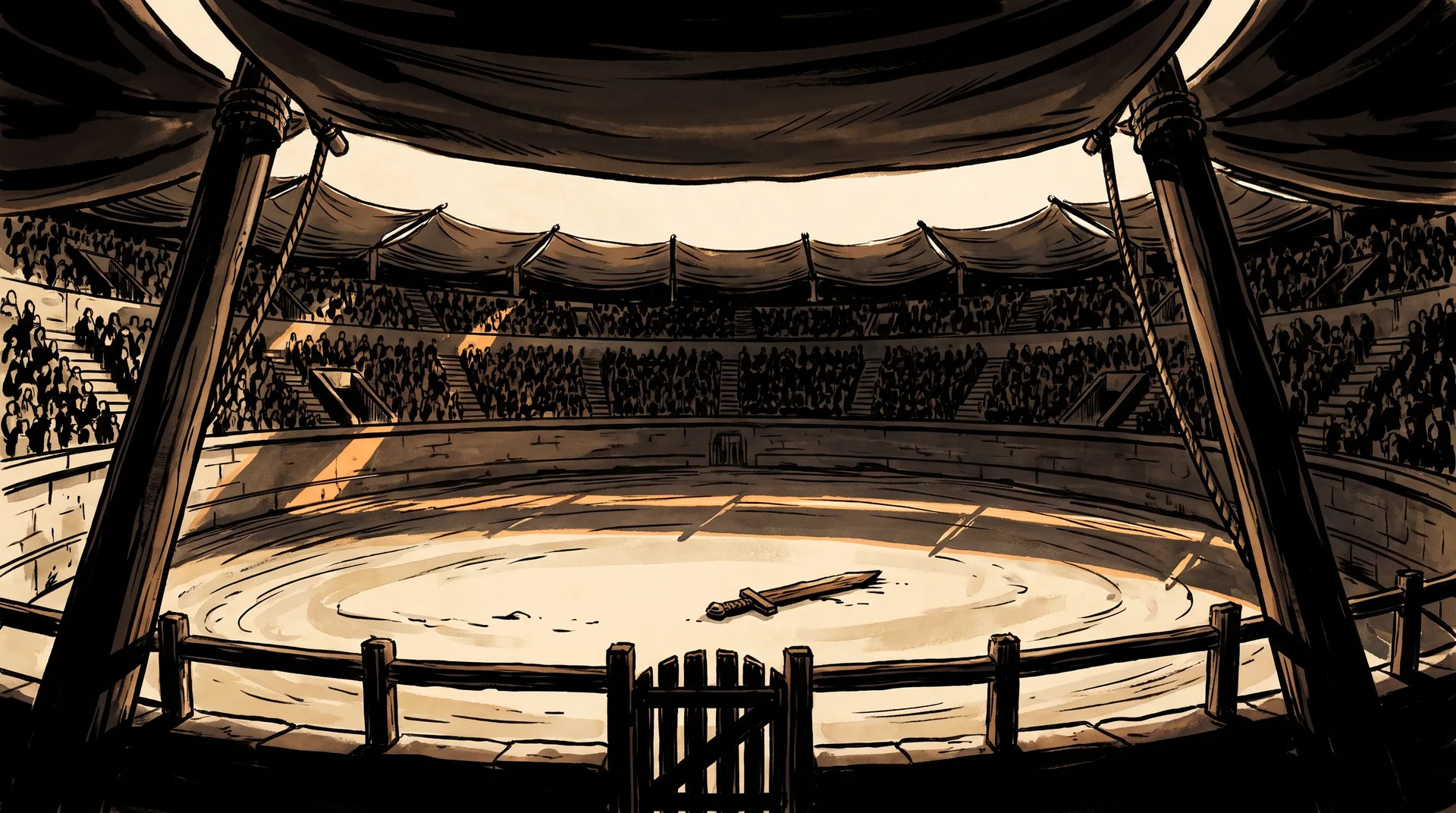
Everything written about Spartacus was written by Romans, by men who were not born when he died, and none of it is long. Plutarch gives him a few pages in the life of Crassus. Appian gives him a few more in the Civil Wars. Florus, Orosius and the summaries of Livy add a sentence here and a number there. Sallust wrote about the war within a generation of it, and only fragments survive. There is no account from the other side.
Before Capua
The sources agree that he was Thracian. Plutarch calls him a Thracian of nomadic stock, which some readers take as a garbled reference to the Maedi, a tribe on the border of Roman Macedonia. Appian says he had once served as a soldier with the Romans, was later taken prisoner and sold to be a gladiator. Florus makes the same story harsher: a Thracian mercenary who became a Roman soldier, then a deserter, then a robber, and then, for his strength, a gladiator.
Plutarch adds the one personal detail anyone bothered to keep. His wife, a prophetess given to the ecstasies of Dionysus, was enslaved with him and was with him at Capua. Plutarch also says Spartacus was more Greek than Thracian in intelligence and temper, which from a Greek writer is a compliment.
The escape and the war
In 73 BC he was one of about seventy men who broke out of the school of Lentulus Batiatus. They chose three leaders: Spartacus, and two Gauls, Crixus and Oenomaus. They took a wagonload of gladiators' arms on the road, beat the soldiers sent from Capua, and camped on Vesuvius.
The praetor Gaius Claudius Glaber sat below with three thousand hastily raised men and waited for hunger to do the work. The gladiators plaited ladders from wild vines, climbed down the cliff on the far side of the mountain, and destroyed his camp from behind. It was the first of a string of Roman defeats. Two more praetorian forces were beaten that year. In 72 BC both consuls took the field and were beaten in turn, and at Mutina in the north Spartacus defeated the governor of Cisalpine Gaul with ten thousand men. By then, Appian says, his army was seventy thousand strong.
Why he then turned south instead of crossing the Alps is the question nobody can answer. Plutarch says he wanted to go home and his men wanted to plunder Italy. Whatever the reason, Rome gave the war to Marcus Licinius Crassus, and Crassus ended it.
The death
In the spring of 71 BC the armies met in Lucania, near the river Silarus. Plutarch says Spartacus killed his horse before the battle, saying that if he won he would have plenty of horses and if he lost he would need none. He tried to cut his way through to Crassus himself, killed two centurions, was wounded in the thigh, and fought on his knees until he was surrounded. Appian says his body was never found. Six thousand prisoners were crucified along the road from Capua to Rome.
Sources
- Plutarch, Life of Crassus 8–11.
- Appian, Civil Wars 1.116–120.
- Florus, Epitome 2.8.
- Sallust, Histories, fragments of book 3.
- Livy, Periochae 95–97.
Checked against the sources on 2026-09-07. Where two ancient authors give different numbers, both are given.