
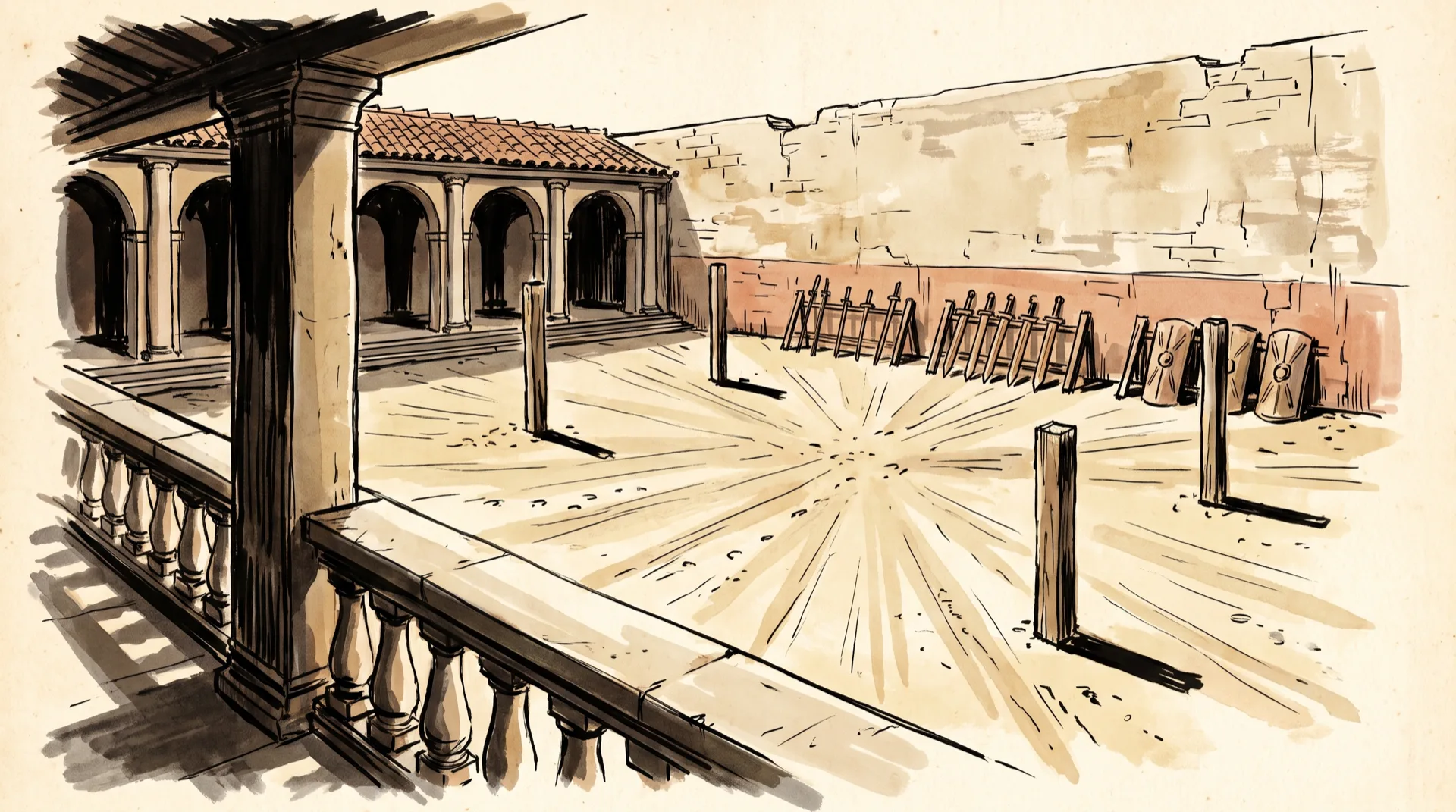
Lentulus Batiatus owned a school of gladiators at Capua in 73 BC. That sentence is nearly everything the ancient world recorded about him. Plutarch, writing about a hundred and fifty years later in his life of Crassus, gives him a name, a city and a business, and then moves on to the men who escaped from him.
What Plutarch says is precise and unflattering. Most of Batiatus's gladiators were Gauls and Thracians. They were kept in close confinement, and Plutarch adds that this was through no fault of their own but through the injustice of their owner. Around two hundred of them planned to break out. The plot was betrayed, and seventy-eight got out before the news reached the house, armed with cleavers and spits taken from a kitchen.
The name
Even the name is uncertain. Plutarch's manuscripts give Lentulus Batiatus, and the name has stuck through every retelling since. Several modern scholars, among them Shackleton Bailey and Ronald Syme, think Batiatus is a scribe's corruption of Vatia, a cognomen of the Servilii, and that the owner of the school was a Gnaeus Cornelius Lentulus Vatia, a man of one of Rome's grandest families by birth or adoption. If so, a senator's family held a gladiator school as a business, which was not unusual and was not something a senator boasted about.
A lanista was, in Roman law, a person of ill repute. He was listed with pimps and actors among the infames, people barred from certain honours and certain courts. The trade was profitable and despised at the same time, and a nobleman who ran one usually did it through an agent.
What is not known
No source says what became of Batiatus after the escape. He is not recorded as killed, punished, ruined or compensated. He does not appear in the war that followed, and he has no known descendants. The school itself vanishes with him. Every death scene written for him since is invention, including the one on television.
That makes him the kind of man this game is about: a provincial businessman whose product walked out of the door one night and became the most famous slave in history.
Sources
- Plutarch, Life of Crassus 8.
- Appian, Civil Wars 1.116.
- D. R. Shackleton Bailey, Two Studies in Roman Nomenclature (1976), on Vatia.
Checked against the sources on 2026-09-07. Where two ancient authors give different numbers, both are given.