
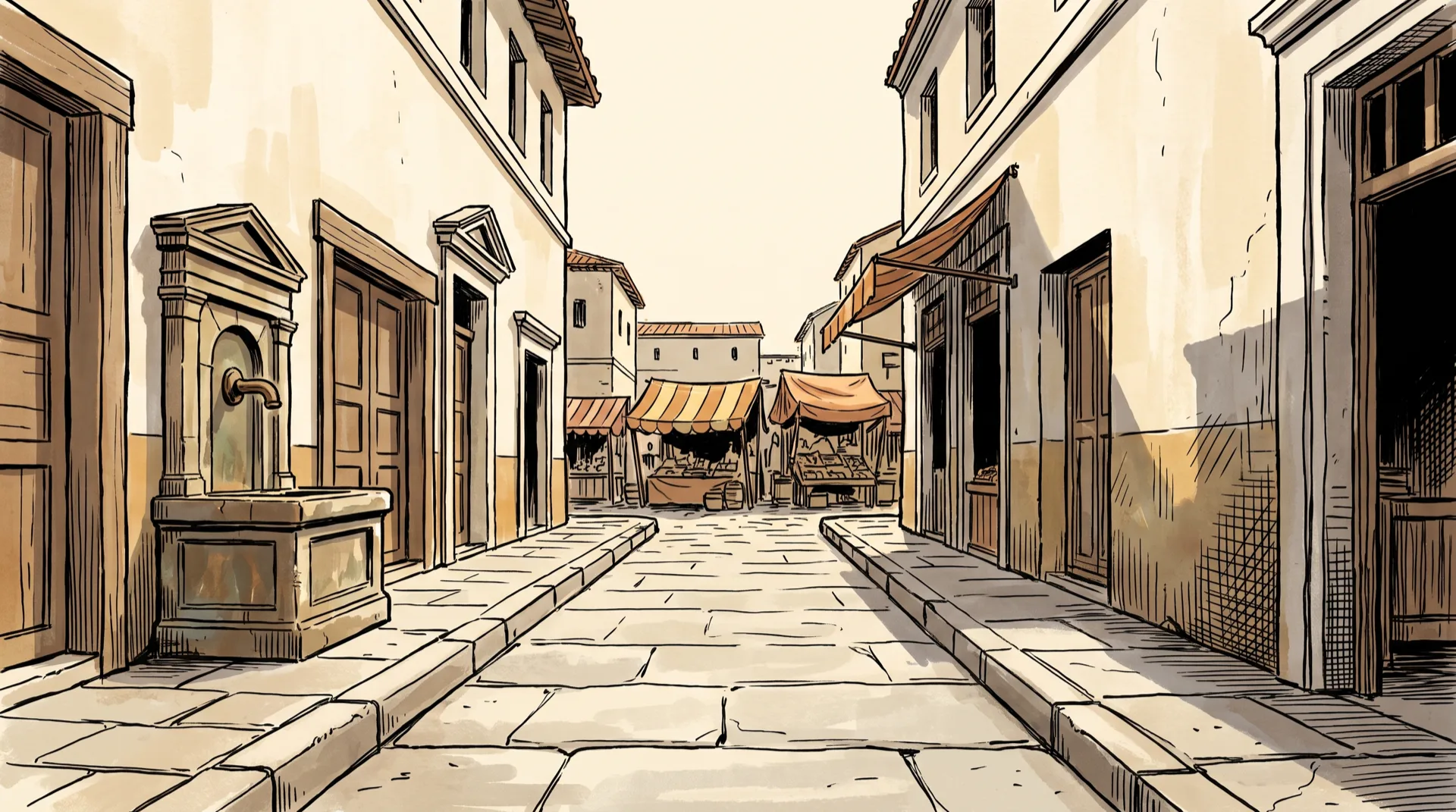
Capua was the great city of Campania, the rich plain south of Rome, and for most of the Republic it was the second city of Italy. It went over to Hannibal after Cannae and was punished for it, and Livy's story that the winter Hannibal's army spent in Capua's comforts was the ruin of it made the city a byword for luxury for the rest of antiquity. It was also, and not by coincidence, where the gladiators came from.
An older taste
The games were not a Roman invention. Painted tombs at Paestum, down the coast, show pairs of armed men fighting at funerals in the fourth century BC, a hundred years before the first recorded games at Rome in 264. Livy says the Campanians, out of contempt for the Samnites they had just beaten in 308 BC, dressed the gladiators at their banquets in Samnite arms, and that is how the Samnite became a type. Whether the games came to Rome from Etruria or from Campania is argued still. Either way, Campania had the habit first.
The schools
By the first century BC Capua was where the schools were. Lentulus Batiatus kept one there with something like two hundred men in it, mostly Gauls and Thracians, and it was from his kitchen that Spartacus walked out in 73 BC. Caesar kept one there a generation later. The Appian Way, Rome's first great road, ran from Rome to Capua, and it was along that road, after the war, that Crassus crucified six thousand of the men Capua had trained.
The amphitheatre that stands at Santa Maria Capua Vetere today, the second largest in Italy after the Colosseum, is Imperial, built in the first and second centuries AD on the site of an older Republican arena. It is not the building Spartacus fought in, but it is the same ground.
Two Capuas
The ancient city is the modern town of Santa Maria Capua Vetere. The town called Capua today is a few kilometres away on the river Volturno, founded in the ninth century AD by survivors of the old city after the Saracens sacked it. Anyone looking for the arena should look for the old name.
Sources
- Livy, History 9.40 and 23.18.
- Strabo, Geography 5.4.
- Plutarch, Life of Crassus 8.
- Appian, Civil Wars 1.120.
Checked against the sources on 2026-09-07. Where two ancient authors give different numbers, both are given.