
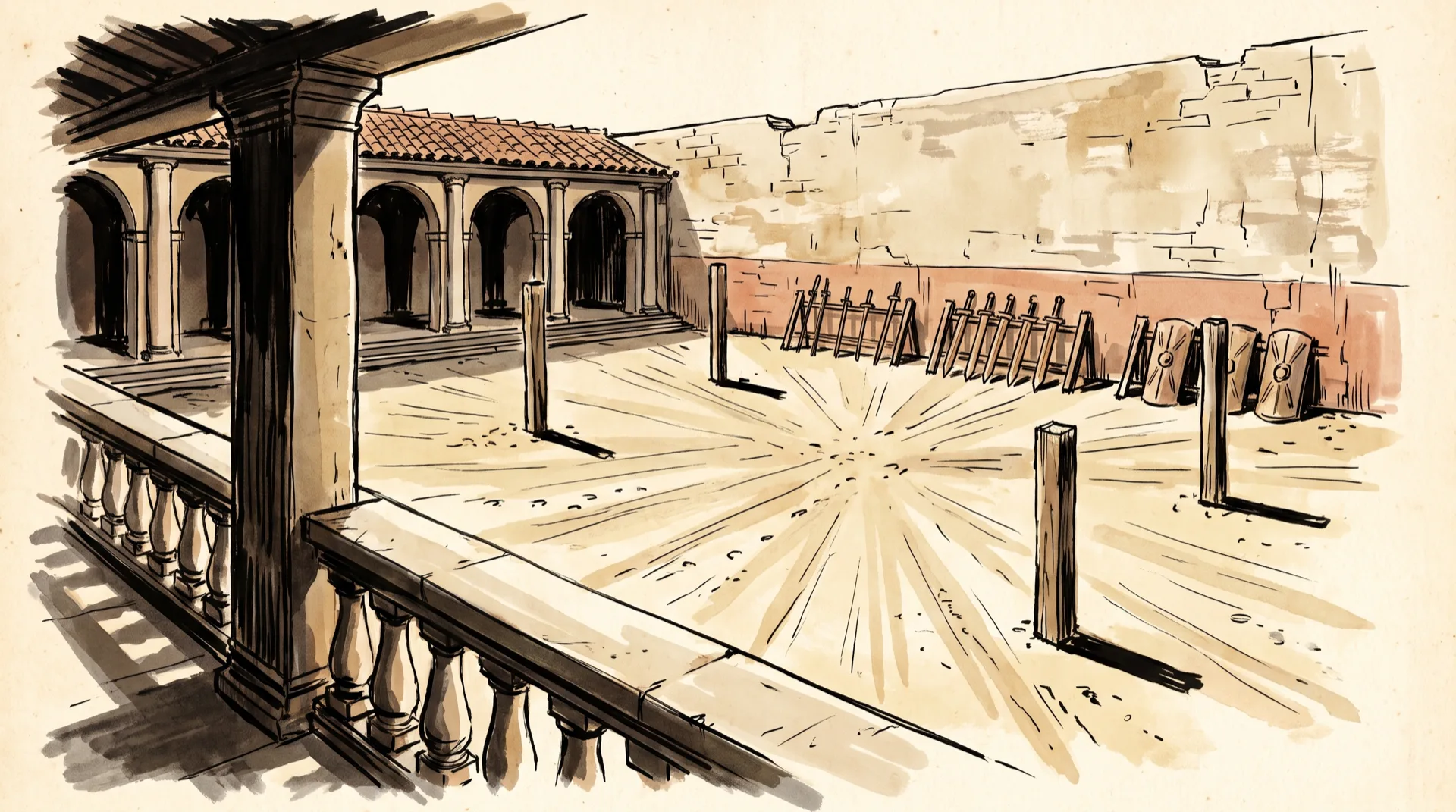
A ludus was a gladiator school, and the men in it were a familia gladiatoria, a household of fighters under one owner. The owner, or the man who ran the school for him, was the lanista. Isidore of Seville, centuries later, claimed the word was Etruscan for an executioner. Whether that is true or a guess, it tells you how the Romans heard it.
The lanista bought men at the block, prisoners of war, condemned criminals, slaves sold on by owners who wanted to be rid of them, and free men who signed themselves over for a fee. He fed, housed, trained and doctored them, and then rented them to whoever was putting on games. The man putting on the games was the editor; he paid for a familia by the day and paid more for a man who died. The lanista's profit was the gap between what a fighter cost him and what an editor would pay to watch him.
Disgrace
The trade was despised in exact proportion to how much Rome enjoyed its product. A lanista was infamis in law, listed with pimps, actors and the gladiators themselves among people who could not hold office, could not represent others in court and could not, in some periods, be buried with respectable people. A senator who wanted the income kept a school through a freedman. Caesar owned one at Capua; in 49 BC his enemies had its men parcelled out two to a household so nobody could arm them.
The people in the house
A working school had a staff. The trainers were doctores, usually retired gladiators, and each specialised in one armature: an inscription will name a doctor of the secutores or a doctor of the thraeces. A physician looked after the men; Galen, the most famous doctor of antiquity, held that post for a school at Pergamum and said it taught him more than the books did. A cook fed them, and Pliny says the fighters were called hordearii, barley men, after what they were fed on. Somebody kept the accounts.
The men had ranks. A tiro was a novice who had not yet fought in public; a veteranus had. Within a school the fighters of each type were graded by palus, the training post, and the primus palus was the best man of his kind in the house. A new man swore the oath that Petronius and Seneca both quote: to be burned, bound, beaten and killed by the sword. It was a slave's condition accepted out loud.
Winning, losing and leaving
A bout did not usually end in a death. A beaten man could raise a finger and ask for missio, discharge from the fight, and the editor, reading the crowd, would grant or refuse it. Augustus banned fights sine missione, with no discharge, as a waste. Modern estimates from tombstones put the odds for a defeated man in the first century AD at roughly one death in five, worsening to one in four by the later empire; every bout also carried a risk of dying afterwards of the wound.
A man who fought well enough, long enough, might be given the rudis, a wooden sword, and with it his discharge from the arena. Some took it and became trainers. Some, being free and famous and poor, signed on again for a fee. When the emperor Marcus Aurelius tried to bring the cost of games down in AD 177, the Senate capped what a gladiator could be hired for by grade, from a few thousand sesterces for the lowest to fifteen thousand for the best in the biggest games, and set the fee a discharged man could ask for coming back at twelve thousand. A good gladiator, in other words, was worth more than a good farm.
Sources
- Petronius, Satyricon 117; Seneca, Letters 37, on the oath.
- Pliny, Natural History 18.72, on barley.
- Suetonius, Augustus 45, on sine missione.
- Cicero, Letters to Atticus 7.14, on Caesar's school at Capua.
- The senatus consultum de pretiis gladiatorum minuendis of AD 177 (inscriptions from Italica and Sardis).
- Georges Ville, La gladiature en Occident (1981), for the death rates.
Checked against the sources on 2026-09-07. Where two ancient authors give different numbers, both are given.